Are Shipping Container Pools Worth It? A Complete 2026 Homeowner Guide
Swimming in a shipping container pool may sound unconventional, but these prefab pool units have sparked a major trend among homeowners looking for an affordable, quick-install backyard oasis. In this comprehensive 2026 guide, we’ll break down exactly what a container pool is, how it compares to traditional and fiberglass pools, and – most importantly – whether it’s worth it for you. We’ll cover the pros and cons, dive into cost and installation, explain lifespan and maintenance, and examine key considerations like permits, heating, and yard suitability. By the end, you’ll have a clear picture of whether a shipping container pool fits your needs, backed by data and expert insights.
What is a Shipping Container Pool?
A shipping container pool is literally a repurposed freight container or a custom steel shell fitted out as a swimming pool. Instead of digging out a hole and building a pool on-site, manufacturers take a standard steel shipping container and retrofit it with a waterproof interior (like a vinyl liner, fiberglass shell, or spray-applied concrete), filtration, and decking. The result is a modular, factory-built pool that you deliver and install almost like a piece of prefab furniture. These pools typically come in standard sizes (usually 20 or 40 feet long and about 8 feet wide) and a fixed rectangular shape. The interior can include steps or benches and can be configured for lap swimming, lounging, or even extra-deep designs. Because of their origin, container pools are made of thick, durable steel (often corrosion-resistant “Corten” steel) that’s designed to withstand ocean shipping, making them structurally very strong. In short, a shipping container pool is an innovative, stylish, and eco-friendly way to add a swimming pool to your yard.
Example of a 20-foot shipping container pool installed above ground with a wood-trimmed rim. These pools have sleek, modern lines and can be fully self-contained units.
Pros of Shipping Container Pools
1. Faster Installation
One of the biggest advantages of a container pool is how quickly you can have a swim-ready pool. Because the shell is pre-built off-site, much of the work happens in the factory. Once on-site, installation might be as simple as placing the container on a leveled pad, hooking up plumbing and electrical, and filling it with water. Many providers report installation in days to a couple of weeks, not months. For example, one pool company notes their units can be delivered and filled within 1–2 weeks, whereas a conventional in-ground pool often takes 3–6 months. Another source emphasizes that container pools are “plug-and-play” units that need only a solid, level surface; they can be up and running in a fraction of the time of a concrete pool. In practice, you can finish most site preparation (a concrete or gravel pad) in a day, drop in the container with a crane, finalize plumbing and filters, and be swimming within 48 hours.
2. Cost-Effectiveness
Container pools typically start well below the price of a custom concrete pool. Many buyers find they can get a 20–40 foot pool for roughly $20,000–60,000 all-in, depending on size and finish. For comparison, a custom in-ground concrete or fiberglass pool often runs $90,000 or more. The main reason is that container pools use a modular shell (lower material and labor costs) and usually require less excavation and construction work on-site. As one industry analysis notes, “shipping container pools present an attractive alternative” by delivering a usable, stylish pool at roughly half the cost of a custom concrete build. They avoid many hidden costs of traditional pools – for example, you typically don’t need a large pool shell built from scratch, and you may not need to build extensive decking or coping. Some container pools are above-ground, which can even reduce fence costs (often only one safety gate is needed instead of four-sided fencing). All told, for homeowners on a budget, container pools often offer big savings while delivering a similar function to smaller fiberglass or vinyl pools.
3. Durable, High-Quality Construction
Shipping containers are made of thick, marine-grade steel (often weathered “Corten” steel) designed to hold huge loads and handle harsh sea conditions, so a container pool has a very strong skeleton. Once it’s built, many container pools include additional rust protection (epoxy coating, galvanized rebar, or even cathodic protection for saltwater systems) and a waterproof liner or fiberglass insert. For example, one guide explains that “high-grade steel containers (Corten steel) resist rust better,” and converting factories often apply sandblasted epoxy coatings plus insulation to maximize longevity. In practice, a well-built container pool can last 15–25 years or more with proper maintenance. This is comparable to, or even better than, some other pool shells. Unlike traditional vinyl pools, for instance, the steel structure won’t collapse or shift with ground settling, and unlike concrete pools, the metal shell won’t crack apart. One comparison article notes that container pools integrating a fiberglass shell have “unmatched durability” and avoid the cracking problems of concrete pools. In short, the rugged steel frame makes container pools structurally durable, provided the interior is sealed correctly.
4. Contemporary Aesthetic
Many homeowners love the modern, industrial-chic look of a container pool. The sleek rectangular shape and exposed metal siding (often painted or clad in wood) give a contemporary feel that meshes well with minimalist or modern landscapes. In fact, some buyers choose them specifically for that clean, stylish design. Because of their unique appearance, shipping container pools can make a backyard stand out visually and even raise property appeal. They pair naturally with the trend of container architecture in homes, bringing an avant-garde statement to your yard. And because the shape is slim and linear, these pools often fit better in tight or urban yards than a big oval or kidney-shaped pool would.
5. Multi-Use Pool Shape (Lap Swimming)
The long, narrow rectangle of a container pool is ideal for lap swimming and exercise. For fitness enthusiasts, a container’s length (often 20–40 feet long) provides a true lap lane, unlike many small round or kidney pools. As one pool expert notes, the shape makes container pools “excellent for racing and swimming laps”. If your main goal is exercise or you enjoy doing laps, a container pool can serve like a built-in swim spa or lap lane. (Just keep in mind the standard width is only about 7–8 feet, so you won’t have the extra wiggle-room that a wider pool shape offers.)
6. Portability and Versatility
Unlike in-ground concrete, a container pool can be moved. If you ever relocate or remodel, you can potentially take the pool with you – the whole container can be lifted out and trucked to a new address. This mobility is truly unique. One marketer even emphasizes that a container pool is something “you can take with you” when moving homes. The modular nature also means installation options: you can set it entirely above ground (fastest and cheapest), partially in-ground, or fully in-ground. Above-ground setups are easiest (no digging), but if you want an integrated look you can drop the container into an excavation. This flexibility lets you choose what fits your yard: for sloped or uneven lots, you might bury one side of the container and leave the other exposed, creating a natural deck on the lower side.
7. Eco-Friendly Repurposing
Many homeowners appreciate the sustainability angle. By reusing an existing steel container, you save it from the scrap heap and reduce new material use. The steel itself is recycled maritime steel that might otherwise sit idle. In addition, these smaller pools use less water than huge in-ground versions. Industry sources highlight that container pools are “eco-friendly” because of repurposing and lower water use. Some builders even offer solar heating packages to power the pump and heater, making the pool off-grid capable. If environmental impact is important to you, the idea of upcycling a container and using clean energy appeals to the eco-conscious buyer.
8. Insurance and Safety (Above-Ground Option)
In many areas, above-ground pools have lower insurance requirements than inground ones. A lifted container pool is often treated like an above-ground pool by insurers. In fact, one supplier notes their insulated container pools “don’t affect most homeowner insurance policies”. Additionally, because it sits above ground, you might not need a full enclosure fence. Many local codes allow a single lockable gate on above-ground pools (as long as it meets barrier standards), which can reduce fencing expense. (Always verify with local codes.) The net effect is potential savings on safety barriers and insurance.
In summary, the pros of container pools are significant: affordability relative to size, rapid installation, durable construction, modern style, good for lap swimming, portability, and sustainability. Many homeowners find these benefits compelling, especially if they don’t need a huge pool.
Cons of Shipping Container Pools
Of course, no pool is perfect, and container pools have notable downsides:
Limited Shape & Design
By nature, shipping containers come only in rectangular “corrugated box” shapes (and most are about 8 feet wide). This means all container pools share that long, skinny profile. If you imagine wide or freeform pools for parties and play, a narrow container can feel restrictive. Kids playing tag or water volleyball will quickly reach the walls. Unlike concrete or fiberglass pools, you can’t easily customize the shape or make a curved play area. There are a few square 8×8 or 10×10 models but they’re rare and still small. In short,
if you want a pool for casual family fun and seating around the edges, a straight container is less ideal – you sacrifice some social splash space.
Single Entry/Exit
Many above-ground container pools end up with only one access point (usually a built-in step or ladder at one corner). If you wanted access from both ends, you might need to install a deck. Only having one exit point can be inconvenient for kids or larger groups. It also can make routine maintenance harder – vacuuming and skimming leaves is tougher if you can’t easily reach all sides.
High Initial Cost (Sometimes)
While container pools can be cheaper than large custom pools, they are
not cheap toys. A fully equipped container pool with insulation, glass windows, or built-in heating can easily push $40,000–60,000. In some cases (especially for large 40-foot models), the final cost with all options can rival a basic fiberglass pool. One industry source warns that once you add delivery, installation, decking, electrical, and landscaping, you might end up around the same total as an
inground pool. In other words, container pools remove some costs but add others (delivery of a 20–40ft steel box isn’t cheap, and you may still want features like decking or heating). If you need a top-end setup, the price advantage narrows.
Potential Heating Challenges
A steel container above ground does not have earth insulation on its sides. This can make it harder to maintain water temperature. Users have noted that container pools can get
very warm in hot climates and lose heat quickly in cold ones. For example, one owner in a desert climate reported their container pool water reached
107°F on a 103°F day, making it unusable without a chiller. Conversely, without insulation, the pool can cool off at night or in winter. To counteract this, many owners must invest in heaters, coolers, or pool covers. In fact, efficient heating often requires either thick insulation or supplemental systems. One container pool maker even offers 2-foot closed-cell foam insulation on all sides so the water can be heated year-round. But without such features, expect higher heating (or cooling) bills compared to an in-ground pool.
Maintenance & Rust Risk
Because the shell is steel, container pools demand diligent maintenance. If the interior leaks or if water chemistry is not well balanced, the metal can corrode. Poor water quality (imbalanced chlorine/pH) can lead to rust spots that, if unchecked, spread and weaken the structure. Users report that without careful upkeep, rust can appear at seams and under welds, eventually leading to leaks. Regular maintenance tasks are essential: balancing the water chemistry, covering the pool when not in use, and promptly repairing any liner scratches or rust spots. In short, a container pool is less “set and forget” than a fiberglass one; it’s more like maintaining a small steel tank. This additional upkeep time and cost should be considered a drawback.
Liner and Waterproofing Quality
Different container pools use different lining methods (sprayed concrete, epoxy coating, vinyl liner, fiberglass insert). Not all are created equal. For example, painted epoxy or sprayed plaster coatings may only last 8–10 years before peeling or cracking. Vinyl liners (if used) will need replacing roughly every 5–9 years. Only high-quality fiberglass shells (with gelcoat) can last for decades without refinishing. The catch is that container pool builders vary widely in skill and materials. Some cheaper providers may skimp on corrosion protection or use thin liners, leading to early failures. (One Reddit user’s cautionary tale described a container pool whose painted liner began peeling in 6 months.) In short, there’s a quality risk: you must vet the builder carefully. A well-made container pool will hold up well, but a poorly built one can quickly become a rusting leaky mess.
Limited Depth
Standard shipping containers are about 8 feet high inside. In practice, most container pools are built shallower (6–7 feet max depth). This means you usually cannot have a deep end for diving (no 8+ foot dive pit) in a container pool. If you need a diving area, a traditional pool may be better.
In summary, the cons are significant: container pools are fixed-shape and somewhat narrow, often only one entry point, and they require attentive maintenance to avoid rust. They may still be pricey once you add features, and heating can be a challenge without good insulation. These factors mean container pools are not a one-size-fits-all solution. They excel for some use cases (lap swimming, quick installs) but fall short for others (wide play area, minimal upkeep). Let’s weigh these in context of costs and use cases below.
Cost and Value of Container Pools
When budgeting, it’s important to look beyond the sticker price of the unit itself.
Base Costs: A basic new container pool (20 feet long, empty shell) might start in the low tens of thousands. For example, some vendors advertise base models around $14,000 (shell plus basic pump/filter). Once you add shipping to your site, installation labor, landscaping, decking, railing, lighting, heating, and electrical work, the price rises. A fully equipped 20-foot container with upgrades can reach $30K–40K, and a 40-foot unit with all bells and whistles can top $60K or more. These ranges overlap heavily with small fiberglass pool costs, but still tend to be lower than high-end concrete installations.
Used Options: Buying a used container pool can slash costs dramatically. You might find a used 20-ft pool for $5,000–$12,000 or a 40-ft for $10K–$20K. (By contrast, brand-new units typically run $15K–$40K.) The trade-off is condition: used pools may need rust repairs or liner replacement. If buying used, do a thorough inspection (check for rust, leaks, sound welds) and include repiping or rewiring costs. Soaked water chemistry (e.g. salt) can accelerate wear. But for the budget-conscious, a secondhand container pool can be a bargain if in good shape.
Installation Expenses: Don’t forget site preparation. Even an above-ground container needs a solid, level base (often a concrete slab or crushed stone pad). Utilities must be brought in: plumbing lines for fill/drain, and electrical for pump/heater. If you connect to a house’s gas line or install a heat pump, that adds cost too. On average, installation labor for a container pool might run $3,000–$10,000 depending on complexity. Compare this to an in-ground pool’s excavation and concrete (often $10K+). The upside is speed: faster install often means lower labor hours overall.
Permits and Codes: Building permits and inspections will add fees (often a few hundred to a few thousand dollars, depending on local fees and pool size). Fencing or safety barriers are typically required by code, which can add another $500–$2000 for materials and labor. You may also need electrical permits for wiring and plumbing permits for any sewer discharge. These costs are similar to any pool project, so factor them in.
Heating & Energy: If you plan year-round use, a heater is key. Gas or electric pool heaters are common ($2K–$5K installed), or solar panels ($5K+). Remember, container pools are very energy-efficient once insulated: they lose less heat than uninsulated above-ground tubs because you can add thick foam insulation. In fact, one container pool maker claims heating costs are “minimal compared to inground pools” due to their insulation. Still, expect to spend on energy to heat (or cool) the water.
Resale and Value: If you ever decide to sell the pool (or move it), container pools hold some value if in good condition, since they can be relocated. However, the main financial benefit is avoiding the high upfront cost of a custom pool. Many homeowners view a container pool as “nearly half the cost of a traditional pool with the same functionality”. So the value proposition is strong if your needs match the container style.
Installation Process & Structure
Installing a shipping container pool involves several steps, often much quicker than a concrete pool build. Here’s a typical process:
- Site Preparation: Choose a level, stable spot with good drainage. Excavate and pour a concrete pad or lay compacted gravel. The pad must handle a heavy load (water weight plus pool structure). Underground utilities (power, water, cable) should be routed to the site ahead of time.
- Delivery and Placement: A crane or large flatbed truck brings the container to your yard. It’s lowered onto the prepared base. This usually takes only a few hours. At this point you have an empty steel box in place.
- Modifications & Hookups: Next, exterior or interior modifications are made. This can include cutting in steps or windows, installing ladders, and adding any decking or trim around the top. Underneath or alongside the pool, the filter, pump, and heater are mounted (often inside a side cabinet or attached space). All plumbing (pipes) and wiring (for pump, lights, heater) are connected. The equipment room in many models is integrated; for example, one image shows a neatly organized pump/filter system built into the container’s frame.
- Lining & Waterproofing: Finally, the interior is finished. Options include a vinyl pool liner custom-fitted to the container size, a pre-formed fiberglass shell glued inside, or spraying a gunite/plaster coating on the walls. Some installers also spray foam insulation on the outside walls at this stage. Each method creates a waterproof barrier. Vinyl liners are common for metal pools (and last about 5–9 years before needing replacement). Fiberglass liners (gelcoat) are more expensive but very durable (often lasting 25+ years with little upkeep). Once lined, all seams and entry points are sealed.
- Filling and Testing: The pool is filled with water and the filtration/heating system is started. A thorough test checks for leaks, pump function, and heater operation. The water chemistry is balanced, and the pool is ready for use. In total, a skilled team can have a basic above-ground container pool installed and filled in a couple of days (though custom features may take up to 2 weeks).
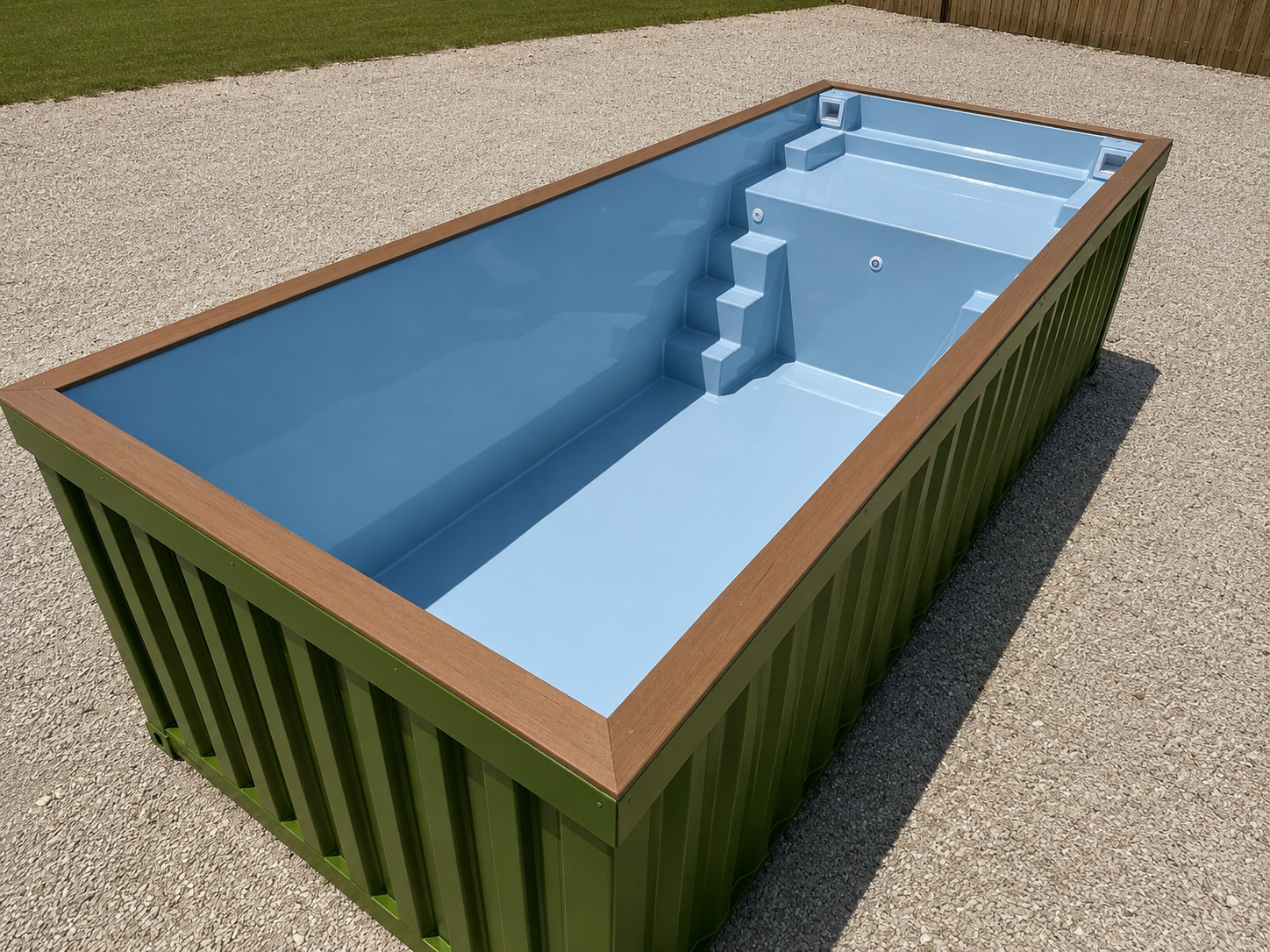
The interior of a 20-ft container pool after lining and fitting. These pools often include built-in steps and waterproof liners or coatings for a smooth, durable finish.
Structurally, container pools are strong. The steel shell is inherently sturdy, and many builders add reinforcements like frame bracing or thicker walls. Some pools come fully insulated: for example, one manufacturer uses over 2 feet of closed-cell spray foam on all sides of the container so the water remains warm year-round. Electrical and plumbing hookups are usually located in a weatherproof compartment, as shown above, protecting equipment from the elements.
Materials, Finishes, and Lifespan
Container Material vs. Traditional Pools
Container pools are essentially steel boxes versus traditional pool shells (concrete, vinyl-lined steel, or fiberglass). The container’s steel is often Corten alloy, which naturally forms a rust-inhibitive patina. Nonetheless, the metal must be painted or coated inside to stay fully waterproof. By contrast:
- Concrete Pools: Made of gunite or shotcrete with plaster finish. Very customizable shape, but subject to cracking. Lifespan ~20–30 years with replastering every decade or so.
- Fiberglass Pools: Factory-made shells of fiberglass-reinforced plastic (gelcoat finish). Very smooth finish, quick install (weeks), crack-resistant, and low-maintenance. Lifespan ~25–30+ years.
- Vinyl-Liner Pools: Steel or polymer wall frame with replaceable vinyl liner. Moderate cost and quick install (similar to container), but liner life ~5–9 years before replacement.
- Container (Steel) Pools: Durable steel shell. Can be installed as-is above ground or in-ground. Interior finish varies: common options include vinyl liner, sprayable concrete, epoxy coating, or drop-in fiberglass panels. Lifespan depends on finish (see table below). The steel structure itself can last
25+ years (many containers are used for decades at sea) if kept waterproof.
In general, container pools share traits of steel and fiberglass models: they’re prefab (fast install) and allow moving, but require careful finishing.
Lifespan of Pool Liners and Finishes
| Interior Liner / Finish | Typical Lifespan (years) |
|---|---|
| Fiberglass Gelcoat Insert | 20+ (decades) [71] |
| Epoxy/Polymer Coating | 8–10 [72] |
| Vinyl Pool Liner | 5–9 [73] |
| Concrete Plaster (Gunite) | ~10 [74] |
A well-made fiberglass insert (gelcoat) is by far the longest-lasting, often enduring decades with minimal maintenance. If the container pool uses a vinyl liner, expect to replace it roughly every 5–9 years, similar to a typical liner pool. Epoxy or polymer coatings (sprayed on walls) usually need refinishing every 8–10 years. Classic plaster finishes are available, but these only last about 10 years before re-plastering and can be rough-textured (requiring more scrubbing).
The takeaway: choose your finish wisely. A vinyl liner is cheapest but not permanent; fiberglass gives a luxury finish but costs more; epoxy spray is a middle ground. All will eventually need upkeep. (By comparison, a concrete pool’s plaster also lasts ~10 years, so some maintenance is common to all pools.)
Longevity and Maintenance
How long do shipping container pools last? With proper care, 15–25 years is a reasonable expectation for the pool structure. The steel container itself can last 25+ years if watertight (as one study of shipping containers notes), but constant water exposure adds stress. To maximize lifespan:
- Protect against rust: Treat all interior metal with waterproof coatings and inspect annually for chips or rust spots. Touch-up paint any scratches promptly. Some owners even add cathodic protection (sacrificial anodes) for extra saltwater resistance.
- Balance your water: Maintain proper pH, chlorine, and alkalinity levels. Bad chemistry accelerates corrosion and liner damage. A reliable filtration system and regular testing (at least weekly) are key.
- Winterize in cold climates: If your pool is above ground in a freezing region, properly drain and cover it to prevent freeze damage. Even buried pools need attention to ensure lines don’t freeze. Insulating the exterior can help extend life in cold areas.
- Regular cleaning: Skim leaves, vacuum debris, and backwash filters. Unclean water fosters algae and biofilm, which both harm finishes and look terrible. A weekly regimen (skimming and vacuuming, along with chemical balancing) goes a long way. Use a pool cover when idle to reduce debris and heat loss.
Following these steps, anecdotal reports show container pools lasting well into their second decade. One real-world example: a container pool in Texas went 20+ years with minimal issues because it was well-built and maintained. Without care, however, owners have seen rapid deterioration. For instance, one family’s container pool liner and coating failed in under a year due to hot temperatures and insufficient maintenance.
In summary, container pools can be long-lasting and affordable but require diligence (as do all pools). In return, you get a sturdy steel shell that, if respected, can provide a lifetime of swimming enjoyment.
Permits, Zoning, and Safety Regulations
Like any pool, installing a container pool triggers local building and safety codes. You will need to check with your city or county before buying. General rule: Treat a container pool just like any above-ground or semi-inground pool. Most areas will require:
- Building Permit: Virtually all municipalities mandate a building permit for any permanent pool. A container pool is still a pool, so expect to submit engineered plans and pass inspection. Even if you drop it in-ground, it’s not considered a “temporary” pool. The permit ensures structural safety and electrical/plumbing compliance.
- Fencing/Barriers: Pool safety laws apply. Many regions require a 4-sided fence with self-latching gate around pools, or at least a gate if it’s elevated. If your container pool is above ground, some codes allow just a lockable barrier at the entrance. However, expect to need child-safe barriers; one guide notes that zoning or building codes often
mandate safety fences for pools.
- Zoning Setbacks: There may be rules for how close the pool can sit to property lines or easements. Check if your lot allows an 8′x40′ box in the proposed spot. Some HOAs have rules on container structures too.
- Electrical/Plumbing Permits: Any wiring (for lights, pumps, heaters) must comply with code, and any drain discharge may require a plumbing permit.
- Special Local Regulations: States like Florida, California, and others have very strict pool regulations (alarms on doors, fencing height, etc.). Always verify the local code details.
Bottom line: Plan for permits in your budget and timeline. Permits ensure you do everything safely. Worst case scenario, failing to get one can cause legal headaches or fines. One recent guide emphasizes that “if you plan on installing a pool, even one constructed from a shipping container, you will most likely need a building permit”. Don’t skip this step – it’s a crucial (and typically inexpensive) part of the project.
Heating and Climate Considerations
Climate matters more for a container pool than for many traditional pools. Without earth insulation, a steel pool can heat up or cool down quickly. Here’s how to manage it:
- Insulation: Some container pools come fully insulated. As mentioned, there are versions with
2 feet of foam insulation on all walls. This makes the pool behave much like a heated hot tub – you can keep it warm even in winter. If you live in a cold region and want year-round use, choose an insulated model or plan to bury the container (covering the sides with soil and siding).
- Heaters and Coolers: In hot climates, you might need a chiller or at least solar-reflective covers to avoid overheating. In cooler climates, plan for a propane, gas, or heat pump pool heater. Because container pools are smaller in volume than full-sized ingrounds, they often heat up faster and require less energy overall. They also cool faster, so a thermal cover is very helpful. Using a
pool cover can save money on heating by retaining heat and reducing evaporation.
- Saltwater Systems: Be cautious if you want saltwater chlorination. The salt can corrode metal, and the container’s walls are still at risk even if you line them. Many experts advise against salt systems in metal pools. If you do use salt, choose a high-quality liner (or epoxy) and stay on top of maintenance to avoid corrosion.
- Winter Care: If your pool is above ground in freezing weather, you must winterize it properly: drain plumbing, cover it well, and possibly even partially drain the water. Steel can crack if water freezes in the wrong place. One simple strategy is to keep some water circulating with a freeze-control pump or to bury the container so the ground insulates it.
In short, heating a container pool is absolutely doable, but plan the extra steps. Well-insulated container pools boast very low heating costs compared to uninsulated ones, but if your pool is uninsulated, expect higher energy use. Conversely, they can heat up very fast in sun (good for lap pools early in the morning) but also become uncomfortably warm in summer without shade or cooling.
Who Should Consider a Container Pool?
Shipping container pools fit certain buyers better than others. They are particularly good for:
- Small or Urban Yards: If space is tight, a neat rectangle is often easier to place than a sprawling freeform pool. The pool above also maximizes the yard’s length while leaving lots of open deck or lawn space. Many urban homeowners who want a lap pool but lack space for a large in-ground pool choose container pools for this reason.
- Fitness Enthusiasts: If you mainly want to swim laps or do aquatic exercise, the container’s length and depth (often 6–7 feet) make it ideal. The focused swim lane feels more like a swim spa.
- Rentals and Short-Term Use: For rental properties (Airbnb, vacation homes) a container pool can be a selling point. It’s a unique feature that can boost appeal. They can also be installed seasonally or moved between properties.
- DIY or Modular Builders: If you like DIY projects or future-proofing, a container pool may appeal. It often comes in one piece and can be plumbed by a handy homeowner. It’s a simpler engineering project than digging out a hole.
- Environmentally Conscious Buyers: If green building matters to you, the recycled-steel aspect is a plus.
On the other hand, a container pool may not be right if:
- You Need a Playground Pool: If your priority is a large shallow play area for parties, you may want a custom-shaped pool instead. The narrow container is not ideal for games or lounge space.
- Maintenance Aversion: If you want “low maintenance forever,” remember that container pools do require upkeep to prevent rust. Some buyers may prefer maintenance-free fiberglass.
- Very Cold Climates (Without Insulation): If you live where ground freezes deep and you don’t plan to insulate, the work to keep it from freezing might be too much hassle.
- If Your HOA or Neighborhood Objects: Some areas or HOAs ban “metal buildings” in yards. Check before purchasing.
Additional Considerations and Tips
- Covers and Accessories: Consider a pool cover (solid or solar blanket) to minimize debris and heat loss. Also think about safety covers if required. Ladder locks, alarms, and gate locks may be necessary for children’s safety.
- Decking: Many owners build a small deck or patio around at least one end of the container, for easy entry and a place to sit. This can also conceal pumps or a skimmer box.
- Landscaping: A creative landscape (plants, lighting) can help the industrial look of the container blend into your backyard. For example, wooden railing or composite trim (as seen in the example photos) can warm the aesthetic.
- Glass Windows: Some container pools have the option of panoramic windows in the sides, which is an exciting visual feature (but adds cost and some risk of breakage). This is optional and not needed for function.
- Reliability of Manufacturer: Because container pools are still a niche market, builders vary in quality. Research reviews, ask for references, and if possible view a working installation. A strong warranty (e.g. 10 years on shell and liner) is a good sign.
- Resale of Used Pools: A used container pool can be bought privately, but beware of hidden problems (rust, poor previous maintenance). Always do a full inspection.
Pros vs. Cons at a Glance
| Pros | Cons |
|---|---|
| Lower base cost than comparable inground pool | Fixed rectangular shape – limited design flexibility |
| Fast, plug-and-play installation (days, not months) | Often only one entry/exit point – less access |
| Very durable steel structure (20–25+ year lifespan) | Can be as expensive as a full pool with all add-ons |
| Eco-friendly reuse of containers, lower water use | High maintenance (watch for rust, liner leaks) |
| Sleek, modern style (good for small yards) | Heats up and cools quickly – may need extra heating/cooling |
| Can be moved to new home (portable) | Quality varies by builder – waterproofing may fail |
| Excellent lap swimming pool design | Saltwater chlorination problematic without proper care |
| Above-ground = simpler fencing (may need only gate) | Limited depth (generally <8 ft) – not for high diving |
Are Container Pools Worth It? The Verdict
Ultimately, whether a container pool is “worth it” depends on your priorities. If you value affordability, speed, and modern design and can accommodate the narrow shape, they can be a brilliant solution. You get a real swimming pool at potentially half the cost and build time of traditional pools, with the bonus of moving it if needed. Many homeowners report high satisfaction when their goal was fitness or a stylish plunge pool.
However, if your vision is a wide family play pool with minimal upkeep, a container might disappoint. The limited width and necessary maintenance are real trade-offs. Compare what you truly need: a container pool is like choosing an above-ground pool that looks like a sleek lap pool. It excels in durability and portability, but at the cost of flexibility and ease of upkeep.
As one pool expert summarized, container pools are a “practical, affordable, and durable alternative” to conventional inground pools with their own unique perks. If those perks align with your needs (smaller yard, fitness, green living, quick project), then yes – a shipping container pool can be worth it. If not, you may be happier with a different type.
Before buying, take a final checklist:
- Measure your space. Will an 8×20 or 8×40 box fit with setbacks?
- Research local building codes (permits, fence, alarms).
- Get multiple quotes (including delivery and install).
- Ask about insulation (2″ foam, propane heater, etc.).
- Consider the interior finish (liner vs fiberglass).
- Plan your maintenance routine (cover, chemicals).
When planned well, a container pool can transform a backyard in days and last for decades. It’s a bold choice, but for the right homeowner, definitely worth considering.
Frequently Asked Questions
Q: Are shipping container pools worth the cost?
A: For many homeowners, yes – especially if you want a real pool on a tighter budget or timeline. Container pools often cost less and install faster than traditional in-ground pools. They give you a functional swimming space at roughly half the price of a large custom concrete pool. Their steel shell also lasts a long time (15–25+ years) with proper maintenance. The trade-off is design flexibility: container pools are fixed-shape and require diligent upkeep. If those fit your needs, they can be a great value.
Q: How much does a shipping container pool cost?
A: Typical prices range from $20,000 to $60,000 all in, for a new container pool (size 20–40 ft). A basic 20-foot pool might start in the $20K–30K range, while a fully customized 40-footer can reach $50K–60K. Used container pools can be far cheaper (often 30–50% less), but inspect for rust or damage first. Remember to budget for site prep, permits, delivery, and any extras (decks, heating, fencing) which add to the final cost.
Q: What are the main advantages of a container pool?
A: Container pools offer fast installation (often days instead of months), durable construction (rugged steel frame plus quality finish), and portability (you can move or repurpose the pool later). They’re also cost-effective for their size – you get a decent-length lap pool for much less than a similar in-ground pool. Other perks include a modern aesthetic and smaller water usage (good for eco-friendliness). Many buyers love the sleek design and the fact that an insulated container pool can be used year-round.
Q: What are the disadvantages or cons?
A: The downsides are mainly the shape and maintenance. All container pools are narrow rectangles (usually ~8 ft wide), so they lack a wide swimming area. They often have only one built-in entry/exit, which can be limiting. Steel pools require regular care to prevent rust – water chemistry must be monitored, and liners/coatings eventually replaced. In very hot or cold climates, container pools can heat up too much or cool down too fast, requiring extra heating/cooling measures. Lastly, if you add many upgrades, the final cost can approach that of a small fibreglass pool, so watch the budget.
Q: How long do shipping container pools last?
A: With good care, the steel shell of a container pool can easily last 20–25 years or more, similar to a fiberglass pool. The interior lining will last less (see table above): fiberglass shells can go decades, epoxy coatings 8–10 years, and vinyl liners 5–9 years. Regular maintenance (covering, balancing chemicals, fixing leaks promptly) is key to reaching the upper end of lifespan. Some documented cases report container pools well-maintained for 20+ years with no major issues.
Q: Do I need a permit for a container pool?
A: Almost certainly yes. Most jurisdictions treat a shipping container pool like any other pool when it comes to permits. You will typically need a building permit (and possibly electrical and plumbing permits) to install it. You will also need to comply with local pool safety rules – for example, installing fencing or barriers and alarms as required by code. Regulations vary by state and city (some even require door alarms or self-closing gates). Always check with your local building or zoning department before you buy.
Q: Can you install a container pool in the ground?
A: Yes, you can set a container pool in-ground. Some owners choose to dig a hole and partially or fully bury the container, then backfill around it for a built-in look. However, even an in-ground container pool is still a delivered prefab unit – the advantage is more insulation and seamless edges. Do note: fully in-ground installation adds time and cost (excavation, backfill, concrete supports). You will likely lose the “portable” aspect once buried, but you gain better temperature stability. If you prefer the pool with only a deck around it (no visible sides), an in-ground or semi-inground installation can achieve that.
Q: How do you heat a shipping container pool?
A: Many container pools use traditional heaters (electric or gas) and heat pumps, just like any pool. In fact, a compact container is easier to heat than a big pool because there’s less volume. Insulation helps enormously – some come with thick foam so they stay warm with minimal heating. Otherwise, you might need a heater or even a chiller in extreme climates. Using a solar cover or insulated blanket is highly recommended to retain heat and reduce energy use. In very hot climates, be aware they can overheat (as one user noted reaching 107°F in summer sun). Proper shading or cooling can be necessary.
Q: Are container pools eco-friendly?
A: Yes, in several ways. They reuse steel containers, which keeps scrap metal out of landfills and reduces new material use. Their relatively small size also means less water consumption than a large pool. Many offer solar heating options to further reduce electricity or gas usage. Industry sources highlight that container pools are a “sustainable choice” that can minimize environmental impact. If you prioritize green building, a container pool is one of the more eco-friendly pool options on the market.
Q: How do I maintain a shipping container pool?
A: Maintenance is similar to any pool, with special attention to the metal shell. You should: 1) Skim and vacuum weekly to keep water clean; 2) Test chemicals at least twice a week and balance pH/chlorine/algae preventers; 3) Backwash or clean the filter regularly; 4) Inspect for rust or liner tears monthly. Using a cover when not swimming saves work by keeping debris out and retaining heat. If you see rust starting, treat it immediately with pool epoxy. In cold weather, winterize by lowering water level and draining equipment lines. Essentially, treat it as an above-ground pool: clean water, check equipment, and protect the structure. This upkeep will ensure your container pool lasts as long as possible.
Q: Are shipping container pools better than traditional pools?
A: They’re different, not strictly better or worse. Compared to a concrete pool, container pools are much faster to install, often cheaper, and easier to remove if needed. Compared to a fiberglass pool, they’re more portable and have a unique look, but fiberglass may need less maintenance over time (no rust worries) and can come in many shapes. The best choice depends on your priorities (cost, time, maintenance, aesthetics). For some homeowners, container pools check all the right boxes. For others who want a custom shape, minimal upkeep, or deep water features, a traditional pool might be more suitable.
Q: Can a container pool leak?
A: Like any pool, yes – if the liner or seals fail. Proper installation minimizes this risk. Vinyl liners can puncture over time, and weld seams or equipment connections might develop leaks if not sealed properly. High-quality container pools use welded or panelized linings to ensure watertight integrity. Annual inspections help catch small leaks early (water chemistry usually alerts you first). In practice, leaks are not inherently more likely than in other above-ground pools – just do your checks.
Q: Are container pools safe for children?
A: They are as safe as any pool in terms of structure. However, because they are often above ground, you still need proper barriers to prevent unsupervised access. Provide safety fences/gates per local code. The good news is that above-ground containers may reduce drowning risk compared to open inground pools because the walls block entry when the gate is locked. Just ensure all safety rules (fencing, alarms, etc.) are followed.
Q: Where can I buy a shipping container pool?
A: You can purchase from specialized container pool manufacturers or dealers (many operate nationwide), or occasionally find used ones on marketplaces. Always choose a reputable company with strong reviews and warranty coverage. Avoid unverified imports – look for U.S.-certified units. (We can’t endorse a specific brand here, but thorough research is key.)
Q: What maintenance risks should I watch out for?
A: The biggest risk is rust/corrosion if the metal shell is exposed to water/chemicals. Keep up with water balance and use pool liners or coatings. Also watch your pump/filter – since container pools often package equipment in one side cabinet, ensure it’s easily accessible for cleaning. Finally, monitor your heater or chiller closely during extreme weather, as their strain can increase in poorly insulated pools.
Q: Can I use a shipping container pool in winter?
A: Yes, especially if insulated. Container pools with thick foam insulation can be heated year-round. In moderate climates, simply using a heater and cover can keep the water swimmable. In freezing regions, you may choose to winterize (drain below freezing point) to protect the structure. Some owners in snowy areas actually keep water circulating with a heater to open all year. Plan based on your local freeze level and pool insulation.
Whether a container pool is worth it comes down to balancing these factors. In many cases, the speed and cost savings make it a great value. Just go in understanding the limitations and responsibilities: if those align with what you want, you could be lounging in your own sleek, modular pool by this summer – without the multi-month construction hassle of a typical pool.